


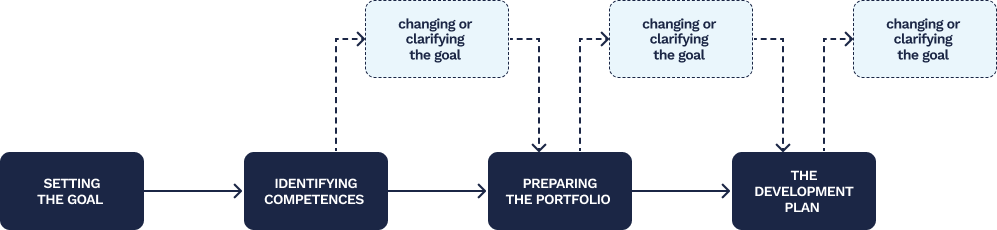
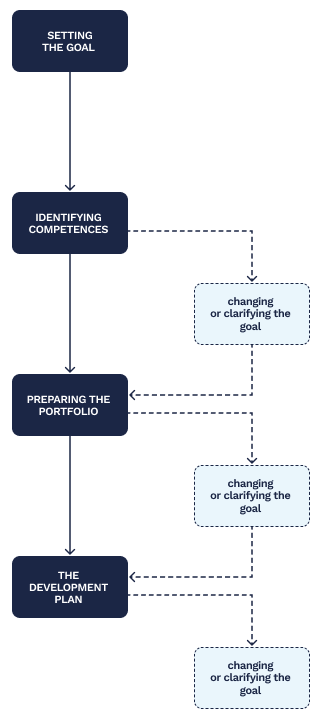
The Skills Audit Method (SAM) is a career counselling tool designed to identify, describe, and document possessed competences, as well as to prepare development plans to achieve educational and/or career goals (Figure 1).
The method may be used by:
The method can be applied when working with various clients, such as:
The method can be applied in various contexts. A client working with a counsellor establishes a preliminary objective related to their educational or professional development, identifies and organises their competences (i.e., knowledge, skills and social competences) acquired throughout their lifetime, both in the workplace and beyond, creates a portfolio of their competences and based on the refined objective as well as identified competences, prepares a development plan. As a result of applying SAM, a portfolio is produced containing a comprehensive list of documented competences accompanied by evidence of their possession (e.g., work samples, photographs, videos, references). This method facilitates preparation for recruitment, career planning and professional development, the discovery and organisation of one’s own resources as well as strengthens self-confidence.
The SAM website provides an extensive set of materials for counsellors to support its application, including: descriptions of individual stages, a practical guide, practical examples, downloadable forms, expert reports and recordings of experts.
A person undergoing a skills audit with the help of a career counsellor:
The counsellor provides the person with feedback on competences. This may concern, for example, the industries in which such a set of competences will be useful or which competences may be missing to allow them to work in a job of their dreams. Depending on the situation and needs of the person doing the assessment, such feedback may be oral or written.
The Skills Audit Method should be conducted by career counsellors, but it is largely based on the client’s own work. A person collects, analyses and organises information from their life. Such self-reflection allows them to see a picture of their strengths and areas in which they may need to develop competences in the context of the set goals.
The Skills Audit consists of several stages. It may be limited to one or two meetings, but sometimes it lasts up to several months. It all depends on the client’s goals as well as the type and extent of support needed from the counsellor.
Before the client decides to do an audit, they should discuss their situation with a career counsellor and receive complete information about what the assessment is and how it is conducted, as well as the required workload, time frame, and expected number of meetings. It is worthwhile for both parties to write up a contract containing arrangements and guidelines for further work.
During the first meeting, the client and the counsellor agree on the initial goal, the scope of the audit, and the work schedule. The scope of identified competences, the number of meetings, the duration of the process, the form and scope of feedback, as well as how much work will be involved in order to complete the skills audit depend on the client’s goal and expectations. The counsellor discusses all these elements with the client before they start working.
It’s possible that during the review, the client will want to reformulate their goal. They can clarify it and add further goals to it. Sometimes the goal changes as the client’s self-image develops in the process of doing the skills audit with the support of the counsellor.

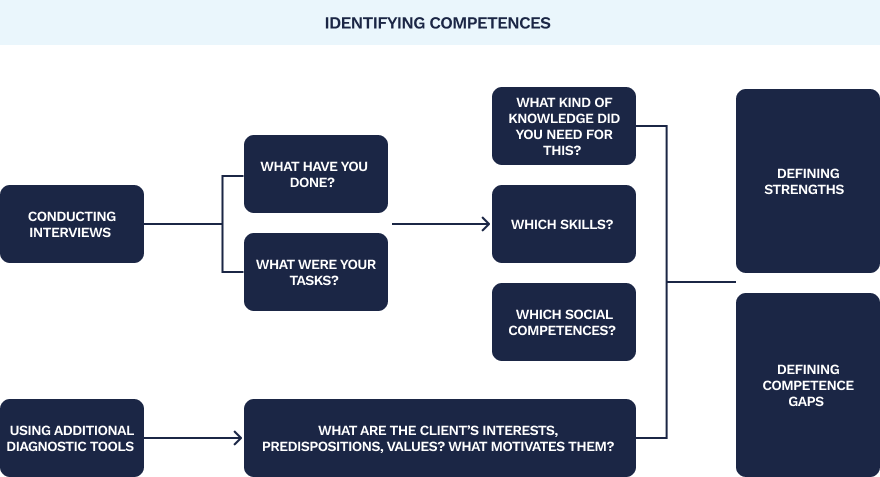
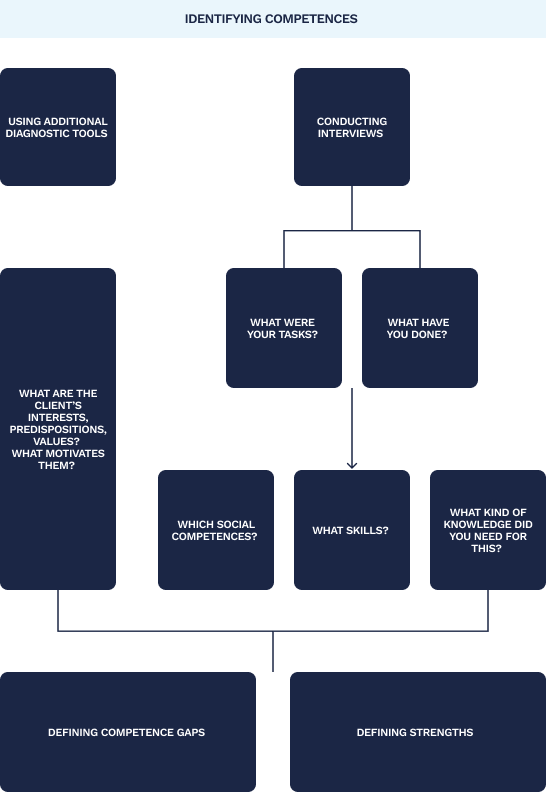
The basis of the assessment is conversation and self-reflection. The counsellor conducts a biographical and behavioural interview. They ask about previous experiences – educational, professional and other. We learn not only at school and work, but also in our free time, taking up hobbies, practicing sports, doing household chores, and volunteering. The purpose of the conversation with the counsellor is to identify the competences that the client has acquired through these different learning paths.
In addition to the conversation, the counsellor may propose additional tools (e.g., tests) to identify strengths, areas for development, and in some cases also professional predispositions and interests. The choice of tools depends on the needs and goals of the person undergoing the audit. Between meetings, the client works independently, for example by writing down his/her educational history or reflecting on questions from the counsellor. Depending on individual predispositions and capabilities, some people will be able to do a large part of the work between meetings on their own. Others will need more support from the counsellor to complete the tests and exercises.
An important element of this stage is also naming competences. Many people need the counsellor’s support in understanding the differences between knowledge, skills and social competences, as well as how they should think about their knowledge and skills in detail. This is also influenced by the goal set by the client. The counsellor’s task is to support the client in moving from the experiences they talk about during biographical and behavioural interviews to naming and writing down competences (Figure 2).

Elena (17 years old) came to Poland from Ukraine to study, and for several years she helped her parents run a guesthouse.
work in my parents’ guesthouse
knows the rules for settling invoices
creates and maintains websites using Squarespace
solves conflict situations
English language course completed
uses English at the B2+ level
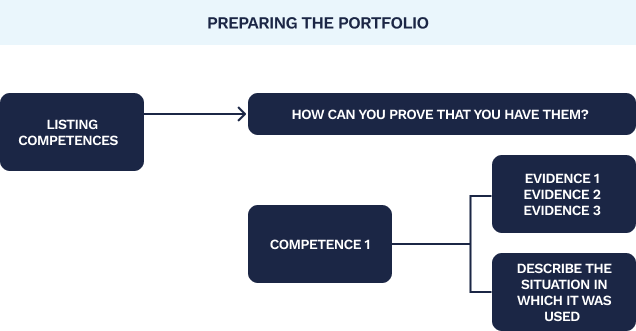
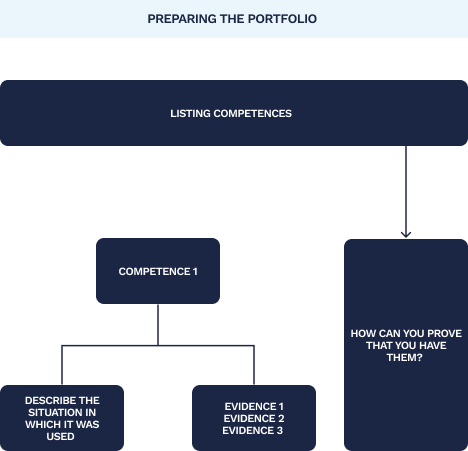
After identifying the client’s knowledge, skills, and social competences, the counsellor helps to prepare a portfolio (Figure 3). It contains everything that proves one’s competences, e.g., documents (including certificates, attestations, qualifications), work samples, photos, videos, presentations, and references.
The form of the portfolio may differ: a folder for collecting paper documents, a table in an Excel file with evidence assigned to individual competences (identified and named in the previous stage of the skills audit) collected in the My Portfolio application, as well as a folder on a computer or in the cloud. It is important that the way of collecting the evidence identified during the skills audit is convenient for the client.
Elena (17 years old) came to Poland from Ukraine to study, and for several years she helped her parents run a guesthouse.
knows the rules for settling invoices
description of the experience of organising and preparing invoices for the accountant of the parent’s company
creates and maintains websites using Squarespace
link to the website of the parents’ guesthouse
print screen of the website’s previous version before its modernisation
resolves conflict situations in relationships with clients
print screen of reactions to negative reviews of guesthouse clients in social media
reference from a colleague
knows English (level B2+)
FCE certificate
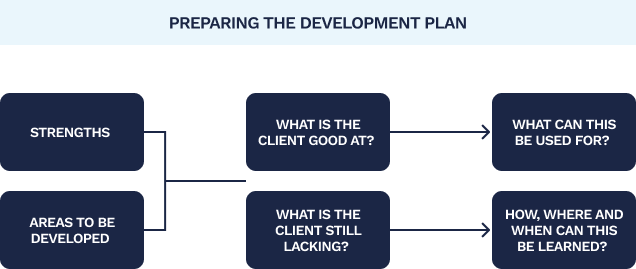
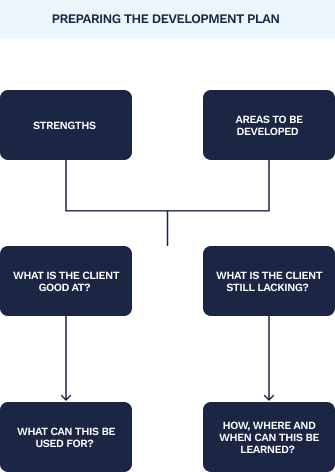
With the support of a career counsellor, the client plans their further professional or educational development step by step (Figure 4). Based on a review of the identified competences, the development plan sets the objectives and methods needed to achieve the client’s goals. An important element of such a plan are activities that can bring the client closer to their ultimate goal, e.g., developing existing competencies or acquiring new ones. The counsellor helps to outline all such elements. It is of utmost importance to set specific time frames in the development plan for achieving the individual objectives and completing the activities.
Figure 4. The stage of preparing a development plan
Maria (22) is studying international relations. Thanks to SAM and her work with the counsellor, she intends to find employment in international trade with China. For this purpose, she wrote a development plan on a timeline (Figure 5).
Figure 5. The sample timeline showing the goals identified as a result of the 2023 skills audit